- Degree of Publicness:
Chapter 36 of the book ‘A Pattern Language’ talks about how people are on a scale of ‘introvert’ to ‘extrovert’ linking to the “introvert-extrovert dimension”. According to Frank Hendricks and Malcom Macnair “Concepts of environmental quality standards is based on lifestyle”. Meaning that people that live close to the action are more extrovert, which includes the residents of the ‘Lijnbaanflats’. By putting these links together from the book towards the building in question it already gives an idea of what to put on the roof based on the general interests of the people living underneath this public space to avoid irritation or even the residents not wanting to visit the public space above their heads. Furthermore, the book states that there are 3 possible pathways to keep both introvert and extroverts comfortable and are as follows;
- Paths along services, wide, open for traffic and crowds
- Paths remote from services, narrow, twisting to discourage traffic
- Intermediate paths linking remote, quite paths to central busy ones
By keeping these 3 possible pathways in mind I can start thinking of a variety of ways to access the rooftops of the ‘Lijnbaanflats’ for all people within the “introvert-extrovert dimension” to feel comfortable and open to exploring this new public space.


- Raised walk:
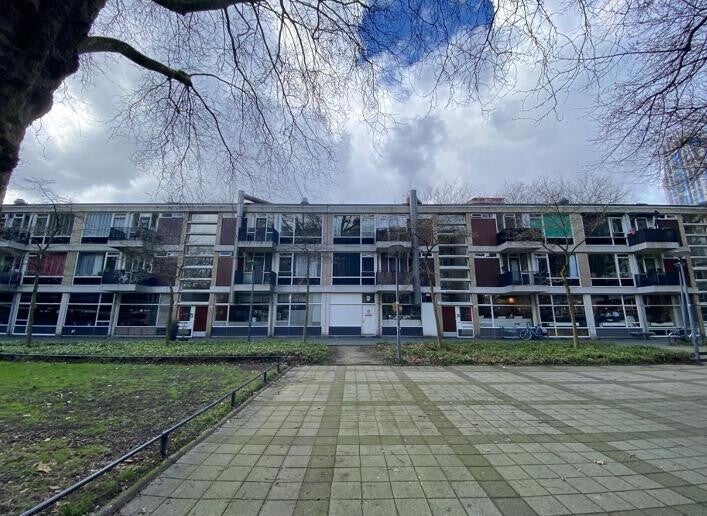
The area around the ‘Lijnbaanflats’ contains many busy streets and activities for pedestrians to attend to (including these rooftops once created). Due to city’s having their well-known busy traffic life with motor vehicles it can make pedestrians feel unsafe. According to chapter 55 there were some allegations made towards this topic. Sidewalks are narrow (Av. length 1.8m) and right next to the roads getting a feeling of being cramped to the side as ‘car is king’. To solve this issue to make the pedestrians feel safer using sidewalks next to the streets should be lifter up by 45cm (for perfection) with the curb being changed into a blockage so there is no way a car can come near (some stairs for idealism and a ramp at every corner for the disabled to access the sidewalk). Looking at the area of the Lijnbaan the pathways where the restaurants are already seeming wide enough clearing that cramped up feeling for pedestrians. However, in the streets between the ‘Lijnbaanflats’ the roads and walk paths are narrow and cramped up on each other, which is the main way people can access the roof and Groundfloor green in the first place. Therefore, I think it is crucial to add these factors to the streets to avoid accidents. Looking at the image above the pavement has already risen due to trams going through this street, however that is not the case for the street on the other side of the ’Lijnbaan’, which will be taken into consideration for this project.
- Accessible green:
Green spaces are needed even though there aren’t many when looking at cities. A study showed that if parks are 3+ mins. away the distance overwhelms the need, which is a big problem in a city as not everyone lives close to a park. People living in apartments want 2 types of outdoor space.
- Useable private balcony
- Quiet public park with walking distance
Therefore, a park can be crucial for the mental well-being of the residents of the ‘Lijnbaanflats’ when close by. Luckily there is enough greenery in the middle of the ‘Lijnbaanflats’, however it needs reconstruction to make it more of a walking distance kind of park from one side to the other of the area.

- Positive outdoor space:
Outdoor space which are ‘left over’ between buildings will in general not be used. There are 2 types of outdoor space.
1) Outdoor space is negative when its shapeless
2) Outdoor space is positive when it has a distinct, defined shape
Another way of defining ‘positive’ and ‘negative’ space is by the degree of enclosure and convexity (being curved outwards). Positive spaces are generally enclosed with paths clearly showing a direction outwards. Negative spaces are poorly defined with no clear boundaries. A solution to make negative space into positive space is by adding greenery, benches etc. To the space to give it a clear purpose. Knowing this and looking at the ‘Lijnbaanflats’ the green in the middle has a clear purpose as it is shaped in the square on both sides. Furthermore, the use of trees, and bushes are well places and there is a clearly defined sidewalk going through the streets from the front to the back of the building.
- High places:
High places have 2 different yet complementary functions. They give people a place to climb up to, from which they can look down onto the world and it gives people a place that can be seen from a far distance. Occasionally building high places throughout a city can make them a natural part of the topography of a city, however buildings do need a physical climb. The reason behind this according to ‘A Pattern Language’ is because high places don’t have a refreshing feeling if there is no physical action needed (E.g. elevator) to get a full sense of the view. Therefore, as the rooftops are overviewing the city of Rotterdam the usage of stairs is going to be key to create such a rewarding feeling for visitors. However, there will be elevators so all people can access the rooftops in case stairs cannot be used by someone.

Maak jouw eigen website met JouwWeb